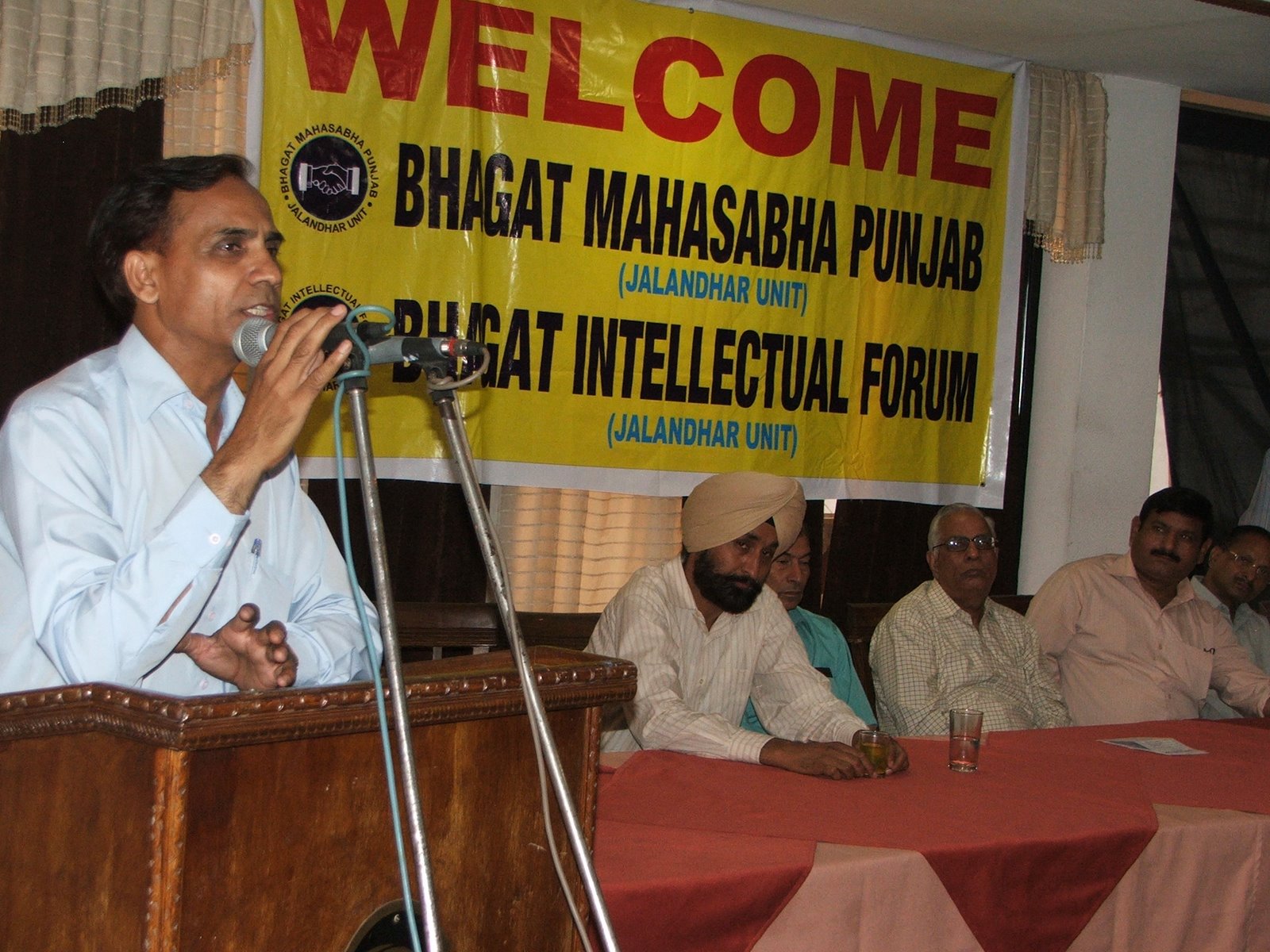
मेघ समाज को एक सूत्र मैं पिरोने के लिए भगत महासभा दूआरा भगत नेटवर्क चलाया जा रहा है !इस में भगत एस एम् एस नेटवर्क के इलावा भगत ईमेल नेटवर्क चलाया जा रहा है !सभी मेघ भाइयों से अपील है की भगत नेटवर्क का मेम्बर बनिए तां की हम अपने समाज की सभी सूचनाएं घर घर तक पहुंचा सकें !
Showing posts with label DAULAT RAM BHAGAT. Show all posts

DAULAT RAM BHAGAT,DODA,J&K

Monday, September 7, 2009


SHADOW LINES
THE DALIT VOICE

‘WE WILL BE MADE SLAVES IN HINDU RAJ’

This is the third of a four-part series, based on a conversation between Yoginder Sikand and Daulat Ram Bhagat, a Kashmiri schoolteacher from the Scheduled Caste Megh community

After 1947, Hindu leaders in Kashmir made efforts to stop the practice of untouchability. Perhaps there was a realisation that if Dalits continued to be suppressed, they might convert to Islam, in which case the Hindus would be reduced to an even smaller minority than they already were in the state. Wherever the Muslim population is higher, you will find that dominant caste Hindus practice a lower degree of untouchability and discrimination vis-à-vis the Dalits. So, in Doda, since the Muslims are a majority, untouchability is not that severe now. But I have had to face caste discrimination myself, despite having been a government school teacher all my life. Once I was posted in a village which had only Hindus living in it and no Dalits. Because I was a Dalit, no Hindu would let me stay in their homes, so I had to live in the school building itself. In many villages in Doda, Dalits are still treated or thought of as lesser beings. In towns things are changing now somewhat because our people are going in for education.


Naorem Ashish

In Doda, Muslims are a majority, so untouchability is not that severe. But I have faced discrimination, despite being a teacher all my life
But in the plains of Jammu, where there are very few Muslims left, discrimination against Dalits by dominant caste Hindus is fairly common. In Doda, we have this massive Muslim population, so it is not possible for dominant caste Hindus to treat us the way they might want, because they know that if they do, we might join hands with the Muslims. So, today, we can eat in Rajputs’ homes and they come to our houses too. But even now some ‘upper’ caste people are opposed to our progress and, though they may not say this openly, they still regard us as inferior. Some ‘upper’ caste people would call me “Masterji” to my face, but behind my back would say, “Oh, that wretched chinal [a term of abuse applied to Meghs], he has the gumption to wear shirt-pant!” Even now many ‘upper’ caste people cannot tolerate the thought of a Dalit in a position of authority over them.

Today, there is much talk of Hindutva and Hindu unity. The RSS and the BJP are particularly vocal about this. They want the Dalits to join their camp too. But you know, in Hindu Raj we will be made to wash the feet of the Brahmins and other so-called ‘upper’ caste people again. We will be forced into slavery again. That we cannot allow. Here in Doda the BJP tried to woo some Dalits, but they were not very successful. They managed to get only very few Dalit supporters. I tried to convince some of these brainwashed Dalits to abandon the BJP. I told them, and I keep telling my people, that the BJP has never raised the severe economic, educational and social problems of the Dalits. If they do, their ‘upper’ caste base will be angered.

To be concluded next week SOURCE www.Tehelka.com

DAULAT RAM BHAGAT,DODA,J&K

DAULAT RAM BHAGAT
SHADOW LINES

‘IN DODA, WE LIVE TOGETHER WELL’

This is the first of a four-part series, based on a conversation between Yoginder Sikand and Daulat Ram Bhagat, a retired school teacher from Doda in Jammu and Kashmir, who belongs to the Scheduled Caste Megh community.

I was 14 years old in 1947, when Partition took place. There was almost no violence in Doda tehsil, nothing compared to what happened in some other parts of Jammu. When the massacres began in Jammu and Punjab, Dalits and Hindus, who were a minority in Doda town, were fearful. But the local Muslims told us they would protect us and insisted that we not leave. The situation was very tense, because many Muslims from Chamba, Udhampur, Chenaini and Bhaderwah had fled to Doda to escape the violence there. Out of fear, some Hindus from Doda town shifted to Hindu-majority villages on the other side of the Chenab.

One night, some Muslims who had recently fled to Doda came to our house, unknown to the local Muslims. Some members of their families had been killed by Sikhs. They accused us of hiding Sikhs in our house. My father denied this and told them they could check and see. Then, as soon as he got the opportunity he jumped out of the window and rushed to the house of his Muslim neighbour, Muhammad Salim Kicchhoo, and told him what was happening. Kicchhoo Sahib ran out of his house, shouting, “Oh Muslims, have you died? These men are threatening to harm our Hindu and Dalit brethren. Don’t let them do so.” Hearing this, a crowd of Muslims rushed to our locality to save us and the men who had entered our house fled.

The situation was very tense, so our neighbours advised us to shift temporarily to Bhela, a Hindu-majority village across the river, till things improved. Most people in our locality went across, but my father stayed on for a few days in the house of a Muslim neighbour. Some days later, the Home Guards of the National Conference arrived and restored peace and we returned to our homes. When we came back, we found that almost everything had remained intact, including our houses and animals, although some personal things like blankets had been taken away.

Shortly after, the Indian Army came. I remember they killed eight or ten innocent Muslim civilians in a Muslim-majority village close by, including a man who was physically handicapped. He had no feet. He used to play the tabla in the Ram Lila celebrations. I feel very bad when I talk or think of this.

Contrary to what newspapers might claim, inter-communal relations in Doda are generally very harmonious. In Bhaderwah and Kishtwar, which are also in Doda district, Hindu-Muslim relations are not so good. One possible reason for this is that there both are roughly equal in number. But in Doda tehsil, Hindus and Dalits are in a small minority and our relations with our Muslim neighbours are good. SOURCE WWW.TEHELKA.COM

To be continued next week

DAULAT RAM BHAGAT,DODA,J&K


SHADOW LINES

‘THEY WOULD NEVER WANT US TO GO AWAY’

This is the second of a four-part series, based on a conversation between Yoginder Sikand and Daulat Ram Bhagat

Hindus and Dalits are in a minority in Doda, and our relations with our Muslim neighbours are good. Unfortunately, this is not widely known to people outside. My daughter married a man from Kathua, an area almost entirely populated by Hindus and Dalits. Her in-laws told me, “how can we come with the marriage party to Doda?” They thought Doda was infested with militants and that the local Muslims were all anti-Hindu and would not spare them. But, eventually, 70 of them came and they were so impressed with the hospitality of the local Muslims that they had to completely change their opinion. Many of them stayed in the houses of our Muslim neighbours, who insisted that they should do so. They treated them as honoured guests. Even the bridegroom stayed in a Muslim neighbour’s home. You will never see this sort of love anywhere else.


Naorem Ashish

We do not fear local Muslims at all. The propaganda about Muslims wanting to drive Hindus out of Doda is wrong
True, some terrible incidents have happened in recent years, but I must say that these are largely instigated by outsiders. We do not fear local Muslims at all. We trust them completely. The bjp propaganda about Muslims wanting to drive Hindus out of Doda is wrong. At least in Doda tehsil, the local Muslims would never want us to go away. As far as I know, most militants generally do not touch people who have not informed on them or opposed them. There have been some massacres of Hindus in Doda in recent years, but local Muslims have condemned these and have said that Islam does not allow the killing of innocents. No true religion can.

About a third of the Hindu population of Doda are Dalits; most are poor and many of them are peasants and manual workers. A small number are government employees. The Meghs are the largest Dalit community in Doda, followed by the Mahashays or Doms and Jogis. Although they are all treated as ‘low’ by the so-called Savarna Hindus, there is no unity among these castes, and they practice forms of untouchability among themselves. Many Meghs, for example, do not eat food cooked by Doms.

Traditionally, and till fairly recently, dominant caste Hindus — Rajputs, Brahmins and Banias — used to practice strict untouchability not just towards Dalits, but also to Muslims. A few continue to do so. Before 1947, many Muslims and most Dalits were poor agricultural labourers and tenants; many times they would be forced to render begar or unpaid labour. The Dogra Raj was a period of great oppression for Dalits and also for many Muslims. So, the Dalits are really grateful to Sheikh Abdullah for saving us from Dogra oppression and ‘upper’ caste domination. The land reforms he instituted gave us ownership over some of the lands we tilled as tenants. That is why most Dalits have always voted for the National Conference.

To be continued next week

DAULAT RAM BHAGAT,DODA,J&K

DAULAT RAM BHAGAT


SHADOW LINES
THE DALIT VOICE

‘EDUCATED DALITS DO NOT WANT US TO RISE’

This is the last of a four-part series based on a conversation between Yoginder Sikand and Daulat Ram Bhagat, a Kashmiri schoolteacher from the Scheduled Caste Megh community

There is no real independent Dalit movement in Doda, although the Bahujan Samaj Party has a slight presence here. There is hardly any Ambedkarite movement among the Dalits of Doda. Only a few educated Dalits have heard of Babasaheb Ambedkar. I came to know about him very late in my life. One problem Dalits here face is that there is hardly any Dalit literature available in the district. There are no Dalit organisations here. It seems that some educated Dalits do not want our own people to rise, fearing that they might compete with them.


Our people cling to Hinduism. For centuries they have been conditioned to believe they are inferior, so they want to hide their identity


I think, as Babasaheb Ambedkar insisted, conversion to an egalitarian religion is essential for Dalit self-respect. Can Dalits gain self-respect while still being treated as Hindus for political purposes? Personally, I don’t consider myself a Hindu. How can I be a Hindu when I am told by the Hindu scriptures that I am ‘low’ and ‘inferior’ to a Brahmin just because of my birth? The Hindu books say that just because I am a Dalit I don’t have the right to read the Vedas. So, how can I call myself a Hindu?

But our people still cling to Hinduism because they have been conditioned to do so for centuries. They have been made to believe that by holding on to the tail of a cow they can attain heaven! Our people have been made to believe that they are inferior, and so they want to hide their identity. Several educated Dalits try to pass off as ‘upper’ caste Hindus. If they do that, of course they cannot work for their own people, because when ‘upper’ caste people see them doing so they will know they are actually Dalits trying to pass off as something else. That is the bane of many of our educated people, who received education and other facilities precisely because of their caste. My own daughter used to study in a college in Jammu; she lived in a hostel there. She clearly told me not to mention our caste name, Bhagat, on my letters to her, fearing that her fellow-students would come to know that she was a Dalit. That is the sort of fear, the urge to deny one’s identity. In this situation, mobilising as Dalits for our rights and identities is, as you can imagine, an uphill struggle.

Concluded Source www.Tehelka.com

Popular Posts